Who Decides Whether a Heli-Ski Day Flies?

Summary
In the United States, the pilot in command is directly responsible for—and the final authority as to—the operation of the aircraft under 14 CFR § 91.3. FAA preflight guidance says the pilot in command must become familiar with available information concerning the flight and identifies planning, weather interpretation and risk identification or mitigation as part of preflight briefing (FAA AC 91-92).
For guests, the useful distinction is between information and authority. A public avalanche forecast is valuable information, but it is not a run-by-run release. Public avalanche forecasts apply to defined geographic areas and forecast periods and include danger information, avalanche problems, travel advice, weather and related risk-reduction information (Avalanche Forecast). Avalanche.org describes an avalanche forecast as a starting point for planning and says risk remains connected to decisions about when, where and how people travel (Get The Forecast).
The sources used here establish the pilot’s aviation authority, the role of preflight information, the scope and limits of public forecasts, and basic passenger-safety subjects. They do not provide a single operating manual for every heli-ski jurisdiction or company.
Who makes which decision?
The pilot: the aviation decision
The legally important answer to “who decides whether the helicopter flies?” is the pilot in command, at least within the U.S. regulatory framework. 14 CFR § 91.3 assigns that person direct responsibility for the aircraft’s operation and final authority over it.
That authority is exercised using the information available for the flight. FAA preflight guidance says the pilot in command must become familiar with available information concerning the flight and identifies planning, weather interpretation and risk identification or mitigation as part of preflight briefing (FAA AC 91-92).
That is narrower—and more useful—than saying that a booking, a favourable bulletin or a clear view from the base guarantees departure. None of those things replaces the pilot’s operational decision.
The avalanche forecast: an area-and-time product
Public avalanche forecasts apply to defined geographic areas and forecast periods and include danger information, avalanche problems, travel advice, weather and related risk-reduction information (Avalanche Forecast).
Its limits matter. The forecast is not written for one aircraft, one group or one landing zone. Avalanche.org describes an avalanche forecast as a starting point for planning and says risk remains connected to decisions about when, where and how people travel (Get The Forecast). For heli-ski guests, the practical takeaway is simple: read the relevant public product, but expect professional decisions to remain specific to the actual operation, terrain, weather, aircraft and information available at the time.
This article does not turn a regional danger rating into a technical run-selection rule.
What the morning usually involves
Before departure
The aviation preparation begins with available flight information and planning. FAA preflight guidance says the pilot in command must become familiar with available information concerning the flight and identifies planning, weather interpretation and risk identification or mitigation as part of preflight briefing (FAA AC 91-92).
Guests do not need to reproduce the pilot’s analysis. They do need to arrive prepared for a decision that may change as information is reviewed. The sources cited here do not set a universal heli-ski decision tree, weather threshold, avalanche threshold or customer policy. Those details can depend on jurisdiction, aircraft, operation, terrain and current conditions.
At the helicopter
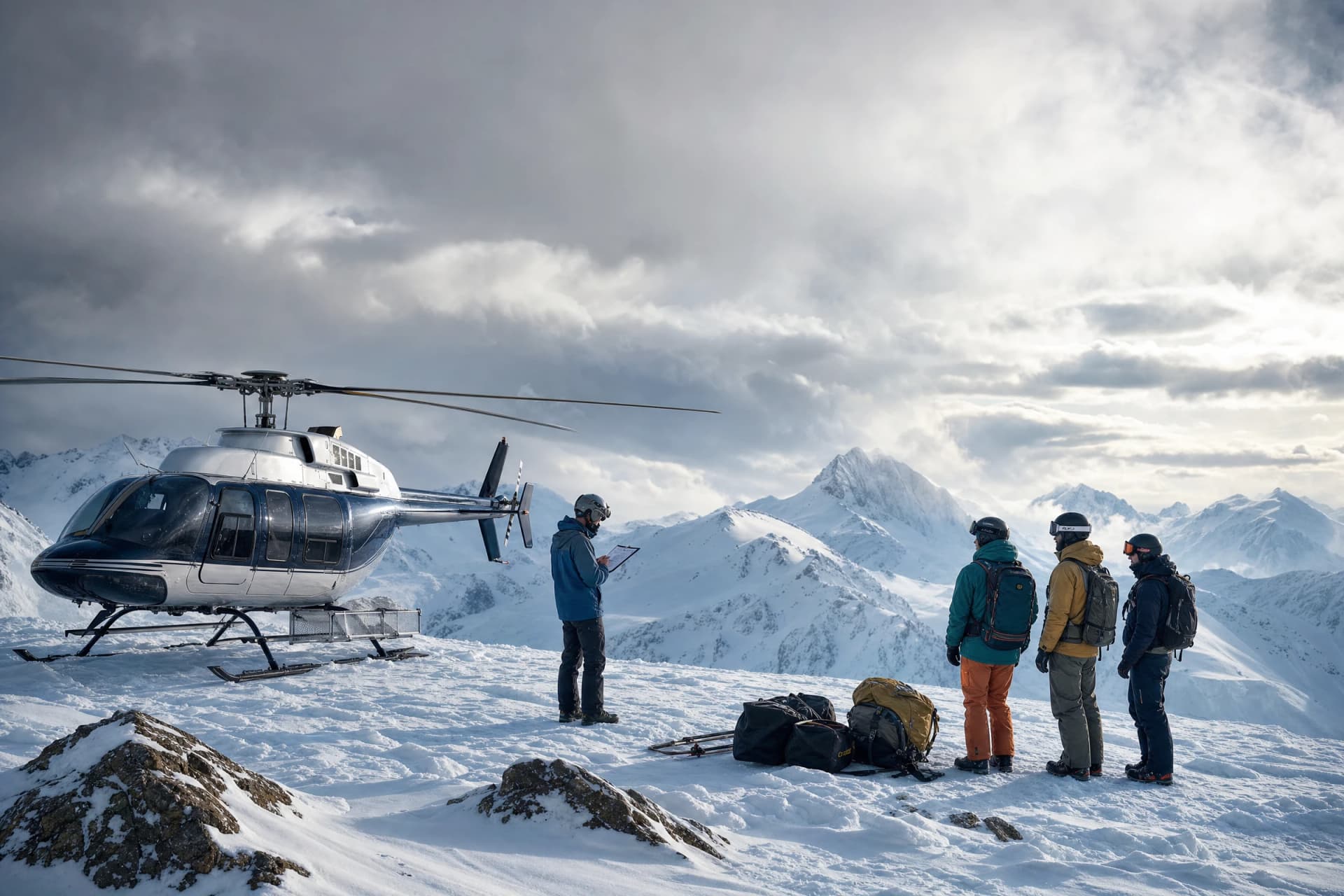
The passenger briefing is part of the operation. FAA helicopter guidance says passenger briefings should address seat belts, doors, headsets or intercom systems, safe entry and exit paths, personal items and relevant emergency actions (Helicopter Flying Handbook, Chapter 8).
FAA helicopter safety guidance says passengers should wait for direction before approaching, should not open doors or release restraints until instructed, and should avoid the rear of the helicopter when walking around it (AC 91-32B).
The exact procedure can differ with the aircraft, landing site, terrain, wind and whether the rotors are turning. The pilot or trained ground crew has the operational instruction; the passenger’s job is to listen and follow it.
During the day
A decision to depart is not a universal promise that every planned part of a day will occur. The sources establish that the pilot works from available flight information and retains final authority over the aircraft (14 CFR § 91.3; FAA AC 91-92). They do not establish one sequence for every heli-ski operation, so no universal sequence is supplied here.
The decision may be revisited when the information changes. That is a normal consequence of operating in an environment where weather, visibility, aircraft status, terrain conditions and other operational factors can change.
What guests should ask—and what they should not assume
A useful question is not simply, “Is the forecast good?” A better question is: What information is being used to decide whether this flight can proceed?
FAA preflight guidance says the pilot in command must become familiar with available information concerning the flight and identifies planning, weather interpretation and risk identification or mitigation as part of preflight briefing (FAA AC 91-92). Public avalanche forecasts apply to defined geographic areas and forecast periods and include danger information, avalanche problems, travel advice, weather and related risk-reduction information (Avalanche Forecast). Those are inputs, not a single universal clearance displayed as one number, colour or screen.
Guests should also avoid assuming that a reservation determines whether an aircraft can operate. Under the U.S. rule cited here, the pilot in command has final authority over the aircraft (14 CFR § 91.3). Commercial cancellation, rescheduling and refund terms are separate operator or contract questions and are not addressed in this article.
The useful mindset
Prepare for the day you hope to ski, but make room for the day the available information actually supports.
The core chain is straightforward:
- The pilot in command has final authority over the aircraft under the U.S. rule cited here.
- Preflight information, weather interpretation and risk review inform the aviation decision.
- A public avalanche forecast describes an area and time window; it is not a run-by-run release.
- Passengers are briefed on aircraft and ground safety and must follow the crew’s instructions.
The sources do not support a single international formula for heli-ski go/no-go decisions. They do support a disciplined division of responsibility: pilots make the aviation decision, professional operations apply their own current procedures and assessments, and guests arrive informed, attentive and ready for conditions to change.
Related reading
Read next

Snow & Safety · Explainer
From Regional Bulletin to Local Decision: What an Avalanche Forecast Can—and Cannot—Tell You
Public avalanche forecasts are regional information products. Research from western Canada explains why local observations still matter, and why a forecast rating should not be mistaken for a terrain-specific approval.
25 Aug 2026
Planning · Explainer
How to Vet a California Heli-Ski Booking Before You Pay
A practical, question-led checklist for checking dates, weather contingencies, ability expectations, equipment, logistics and cancellation terms before committing to a heli-ski day.
25 Aug 2026
Gear & Skills · Article
Bella Coola Heliski: Exclusive Wilderness Adventures with Heliski International
At Heliski International, we partner with the world’s top heliski operators to offer our clients the most unforgettable experiences in the mountains. Bella Coola Heliski, one of our exclusive operators, takes heliskiing to a whole new…
11 Feb 2025