From Regional Bulletin to Local Decision: What an Avalanche Forecast Can—and Cannot—Tell You

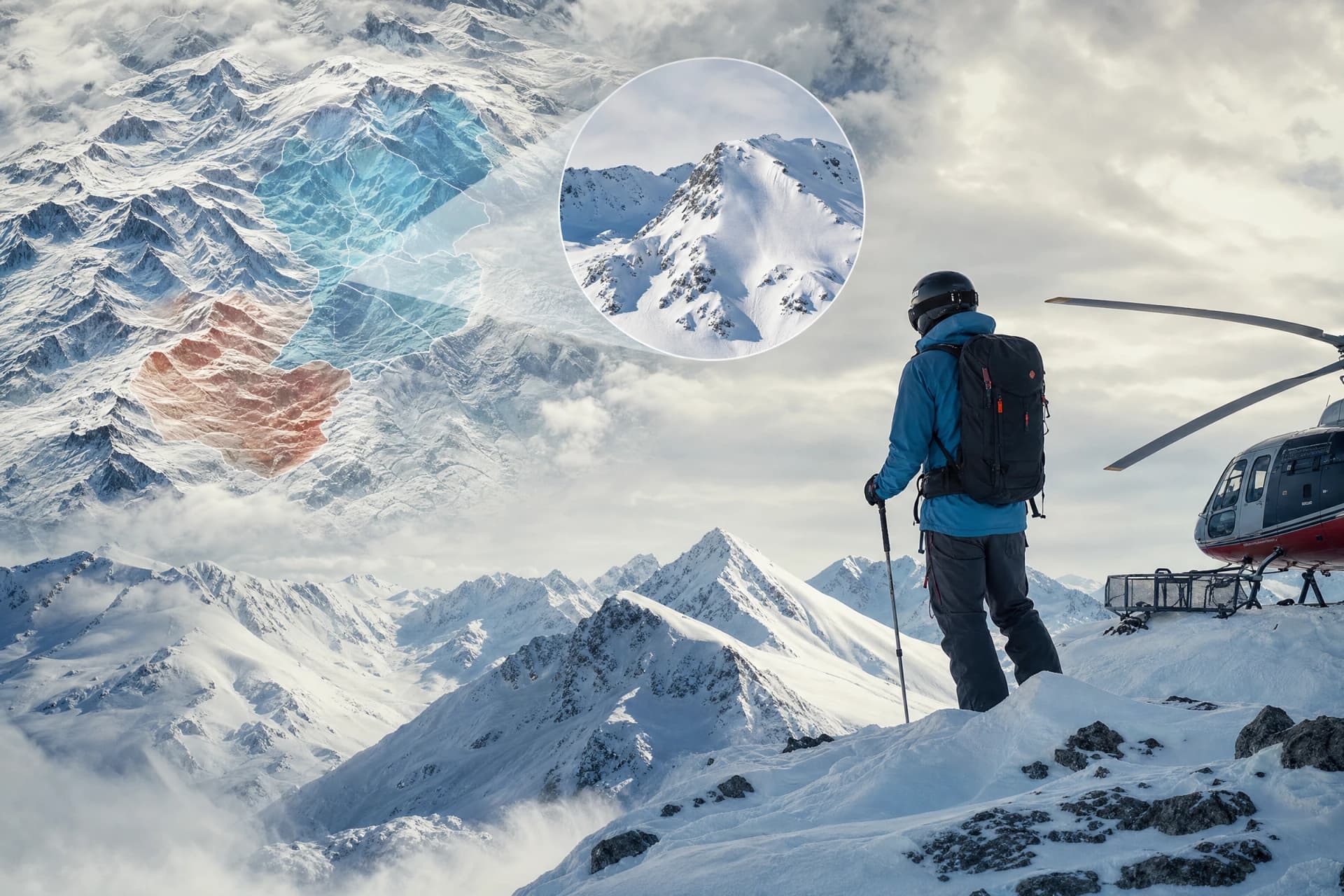
A public avalanche forecast is useful precisely because it works at a regional scale. It summarizes avalanche danger and associated snowpack conditions across a defined forecast area, giving people a common starting point for understanding the day.
It is not, however, a clearance for a particular slope, run or route.
What the public forecast provides
Public avalanche forecasts provide an assessment of avalanche danger and associated snowpack conditions, and are intended as a starting point for travel decisions rather than a complete approval for when, where and how to travel. The National Avalanche Center explains that distinction.
That wording matters. A forecast communicates an expert assessment over an area. It does not know the precise line a person may choose, the exact timing of a decision or every condition that may be encountered in the field.
The forecast is therefore an important source of information, but it does not remove the need for judgment at the location where people will travel.
Why regional and local danger can differ
Regional avalanche danger can differ from local danger because of spatial variability, forecast-region scale, changing weather and snowpack, unavailable or stale data and forecast limitations. This is the central scale problem examined in a peer-reviewed study of the Columbia Mountains of western Canada. (Field observations for estimating the local avalanche danger in the Columbia Mountains of Canada)
A forecast region may cover a large and varied landscape. Elevation, aspect, wind loading, precipitation, snowpack structure and recent avalanche activity can differ within that area. Conditions can also change after a bulletin is issued, while relevant observations may not have been available to the forecaster at the time of publication.
None of this makes a regional bulletin unhelpful. It explains what the bulletin can reasonably do: describe the broader situation and provide a framework for interpreting local evidence.
The role of local observations
The Columbia Mountains study states that experienced recreationists routinely use the regional forecast along with local observations to estimate local avalanche danger. (Field observations for estimating the local avalanche danger in the Columbia Mountains of Canada)
The study considered observations of weather, avalanche activity and snowpack conditions. Its purpose was not to create a universal checklist, but to examine how information at different scales relates to local danger ratings.
The practical point is straightforward: a regional rating should be read together with what is known about the terrain and conditions being considered. Local evidence does not automatically make a route safe, and the absence of an obvious warning sign does not prove stability. It adds information to a decision that remains specific to the place and circumstances.
The forecast as an initial estimate
The study describes the regional forecast as an initial estimate of local avalanche danger that should be checked against local conditions. (Field observations for estimating the local avalanche danger in the Columbia Mountains of Canada)
That does not mean every traveler can independently reproduce a professional avalanche forecast. The study itself notes that verifying a bulletin can require expert knowledge, including snow profiles and stability tests. Nor does it mean that one local observation should be treated as decisive in isolation.
It means the scale of the forecast and the scale of the decision should be kept in view. Regional information describes a broad pattern; local assessment asks how that pattern appears in the terrain at hand.
What the study found about combining information
In the study, a regional danger rating combined with three selected local observations agreed better with the local danger rating than the regional rating by itself. (Field observations for estimating the local avalanche danger in the Columbia Mountains of Canada)
This is a finding about that study's observations, methods and mountain environment. It is not a prescription to collect exactly three observations, nor evidence that a fixed combination works everywhere. The relevant lesson is narrower: information from different spatial scales can complement one another.
The researchers found that some weather variables related more closely to the regional forecast, while some snowpack observations related more closely to local danger. That is consistent with the basic logic of avalanche forecasting: different observations describe different parts of the problem.
What a guest or recreational traveler should not assume
A public forecast should not be read as telling you:
- that a particular slope is open or appropriate;
- that conditions are uniform across the entire forecast area;
- that a lower danger rating eliminates the need for local judgment;
- that one observation can overrule the wider weather and snowpack picture; or
- that a forecast remains unchanged as conditions evolve.
Those are not shortcomings of the public product. They are boundaries on what a regional forecast is designed to communicate.
A useful question is not simply, “What is today's danger rating?” It is, “What does that rating describe, what local information is available, and how might conditions differ at the terrain being considered?”
The useful dividing line
The dividing line is simple:
- Public avalanche forecast: a regional assessment of avalanche danger and associated snowpack conditions.
- Local decision: an interpretation of that regional information alongside current observations and the specific terrain and circumstances under consideration.
The first informs the second. It does not replace it. Avalanche.org describes the public forecast as a starting point, while the Columbia Mountains research documents why local conditions still require attention. (Field observations for estimating the local avalanche danger in the Columbia Mountains of Canada)
That is the defensible way to read a bulletin: use it for regional context, then assess the decision at the scale where people will actually travel.
Related reading
Read next
Snow & Safety · Explainer
Who Decides Whether a Heli-Ski Day Flies?
A practical explanation of the heli-ski go/no-go decision: the pilot in command’s authority, the role of preflight information, the limits of public avalanche forecasts and the passenger briefing before departure.
25 Aug 2026
Planning · Explainer
How to Vet a California Heli-Ski Booking Before You Pay
A practical, question-led checklist for checking dates, weather contingencies, ability expectations, equipment, logistics and cancellation terms before committing to a heli-ski day.
25 Aug 2026
Gear & Skills · Article
Bella Coola Heliski: Exclusive Wilderness Adventures with Heliski International
At Heliski International, we partner with the world’s top heliski operators to offer our clients the most unforgettable experiences in the mountains. Bella Coola Heliski, one of our exclusive operators, takes heliskiing to a whole new…
11 Feb 2025